We are just days from Christmas and if you rely on online businesses and shipping, there might be a big chance that you won't get your gifts unless you order pretty soon. With that in mind Amazon has just slashed €30 of the Kindle Fire HDX 7 tablet, at least on its German website.
.jpg) The new Kindle Fire HDX with a Snapdragon 800 processor, great screen and 16GB of storage features just one downside, a locked down operating system, but then again it is selling for just €199. The 32GB version now sells for €239, while the 64GB version is €279, much less than an iPad mini with Retina with comparable storage.
The new Kindle Fire HDX with a Snapdragon 800 processor, great screen and 16GB of storage features just one downside, a locked down operating system, but then again it is selling for just €199. The 32GB version now sells for €239, while the 64GB version is €279, much less than an iPad mini with Retina with comparable storage.
The new Kindle Fire HDX with a Snapdragon 800 processor, great screen and 16GB of storage features just one downside, a locked down operating system, but then again it is selling for just €199. The 32GB version now sells for €239, while the 64GB version is €279, much less than an iPad mini with Retina with comparable storage.
Amazon wants 14 euro more if you want the Kindle HDX without adverts on it and LTE versions starts at €309 for 16GB, $349 for 32GB and €389 for the 64GB version.
The same deal works for UK customers who can now buy a Kindle Fire HDX for £169.00 for 16GB, £199.00 for 32GB and £229.00 for 64GB, or £30.00 less than yesterday. Amazon was not so kind to French and Spanish customers as they are not getting this rather sizable discount, at least not yet.

Amazon.com made headlines this week with the announcement of Amazon Prime Air, but it isn't the only company that's testing delivery drones.
Reports this week say UPS and Google are two other companies that are also testing delivery drones for their services.
Unnamed sources say UPS is "testing and evaluating" different ways that it could add drones to its fleet of brown delivery vehicles, according to The Verge. Though UPS has not confirmed this report, the company did not dismiss it either.
"The commercial use of drones is an interesting technology and we’ll continue to evaluate it," UPS said in a statement. "UPS invests more in technology than any other company in the delivery business, and we’re always planning for the future."
In Silicon Valley, Google is also testing delivery drones. Reports from as far back as February by news site 9to5Google say Google has been testing "mini-drone delivery systems" that it would like to use with Google Shopping Express, a same-day delivery service available in San Francisco and surrounding areas.
The Google drones come from Google X, the same department that is responsible for Google Glass and the company's self-driving cars, according to 9to5Google.
Some day soon, we'll likely receive our packages from drones; but first, government regulations need to change.
Source : latimes.com

It’s the biggest shopping day of the year, but it looks like the deals are getting started extra early at Amazon for all you gadget, gaming and entertainment fans in the audience. Yes, Black Friday isn’t officially until November 29th, but Amazon’s sale is kicking off this Sunday, November 24 with deep discounts coming as often as every ten minutes.
There are tons of highlights in terms of electronics, as well as video games, books, movies, coffee makers and more. You can get a Vizio 55-inch 1080p Smart HDTV for just $479.99, for example or a 50-inch Seiki LED HDTV for $229. A Sony BDP-S3100 Blu-Ray player is on sale for $54.99, a Canon T3 DSLR is “under $400,” and an HTC One is just a penny when you sign a contract with Sprint, Verizon or AT&T.
Some of the other goodies include a PS3 250GB bundle with The Last of Us and Batman: Arkham Origins for $199, Call of Duty Ghosts for $39.96, buy two get one free Skylanders Swap Force characters, up to 63 percent off thousands of movies and TV shows, a Mr. Coffee single cup Keurig coffee brewer for $64.99 and more.
The best way to keep tabs on what you can score is to bookmark the Amazon Black Friday Hub page and visit it periodically over the course of the whole week leading up to Black Friday. Good luck and happy shopping!
Source : The Verge
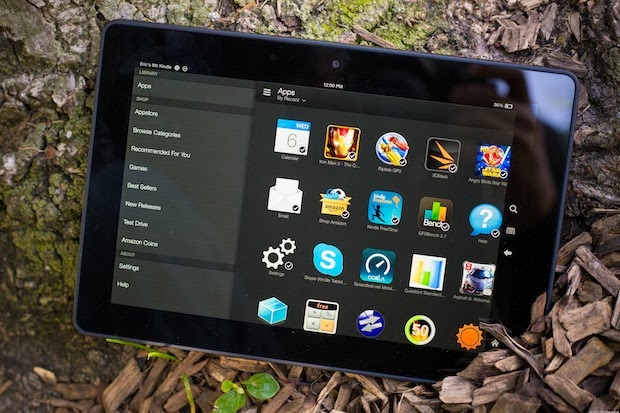
Amazon is refreshing its tablet software, designed for its next-generation Kindle tablets, including the recently announced Kindle Fire HD and Fire HDX.
IT managers haven't been kept out of the loop either: Fire OS 3.1 comes with new Kindle-specific device management hooks (APIs) that will integrate with existing mobile device management (MDM) systems.The Seattle, Wash.-based company touted new enterprise features in its Fire OS 3.1 update that will support bring-your-own-device (BYOD) users with secure Wi-Fi network support and native virtual-private networking (VPN) software.
Also added:
- Voice dictation available in all languages converts speech-to-text. For enterprise users, offline support is available in U.S. English only.
- 1-Tap archive frees up device space by pushing content into the cloud for later downloading, and identifying content that has not been used recently
- Fire OS now supports Kerberos authentication, enabling the ability to browse secure Intranet websites from the Silk browser
- Wireless printing of photos, PDF documents, emails, contacts, calendar, and documents
- A new feature opened up, Second Screen, allows you to turn your television into a primary screen while using your Kindle Fire HD or Fire HDX tablet as a space to check email, browse the Web, or access to other apps.
Fire OS 3.1 also lands with Cloud Collections, which helps to organize books, newspapers, magazines, and apps in customized collections for easy reference. Amazon’s cloud-powered Whispersync synchronizes the collections across Kindle devices so that content is available on all of your devices.
For book lovers, Goodreads is now integrated, allowing users to find the latest books and engage with others on book discussion.
Performance and battery life has also been improved, and the update comes with a round of bug fixes.
Via: ZDNet

Amazon doesn’t want to just be known as your entertainment portal—it wants to be your everything portal. The company hopes to continue to instill that vibe with the latestsoftware update for its Android-based tablet line. Fire OS 3.1 begins rolling out Monday to Kindle Fire HD and Fire HDX devices, bringing with it a few new features, like enterprise support and wireless printing to turn your existing Kindle into more than just a destination for ebooks and video. The update also beefs up the last-generation Kindle Fire HD with some of the HDX’s marquee features.
BYOD, finally
For Amazon to make its tablets a be-all, end-all device for consumers, it needed to cater to the business crowd, too. The device now includes better enterprise support with features like the ability to connect to secure Wi-Fi networks and log on to a corporate network via VPN. Fire OS 3.1 also supports Kerberos authentication for more secure browsing of your company’s internal Intranet through the Silk browser, as well as a Kindle-specific device management API to make life easier on your IT department.
See what your friends are reading
Amazon aims to be more friendly with the integrated Goodreads social network for book lovers. The service lets you connect with friends to share things like your favorite quotes, what you’re currently reading, and what you thought of the books you’ve read. You can also import every book you’ve ever bought or read through Amazon into your Goodreads account and sign up for a daily or weekly newsletter that offers suggestions on what’s new to read in your favorite genres.
Share your screen with your TV
As if the Amazon Video app on almost every set-top box out there wasn’t enough, the bundled Second Screen feature is now supported for the older Kindle Fire HD. Second Screen lets you “fling” movies from your Kindle to your television set through supported third-party devices. Amazon writes that the feature is meant to free up your device so that you can use it for apps like X-Ray or browsing the Web—a definite ploy to get you to always use the device when you’re thinking of entertainment in your living room. The feature is currently limited to the PlayStation 3 and compatible Samsung TVs, though Amazon writes that it will be available later this year for the just-released PlayStation 4.
Other miscellaneous features in Fire OS 3.1 include things like wireless printing and voice dictation to convert your speech into text. Voice dictation is available in all languages when you’re connected to a network, though only English is available offline.
Source : TechHive

Amazon is refreshing its tablet software, designed for its next-generation Kindle tablets, including the recently announced Kindle Fire HD and Fire HDX.
IT managers haven't been kept out of the loop either: Fire OS 3.1 comes with new Kindle-specific device management hooks (APIs) that will integrate with existing mobile device management (MDM) systems.The Seattle, Wash.-based company touted new enterprise features in its Fire OS 3.1 update that will support bring-your-own-device (BYOD) users with secure Wi-Fi network support and native virtual-private networking (VPN) software.
Also added:
- Voice dictation available in all languages converts speech-to-text. For enterprise users, offline support is available in U.S. English only.
- 1-Tap archive frees up device space by pushing content into the cloud for later downloading, and identifying content that has not been used recently
- Fire OS now supports Kerberos authentication, enabling the ability to browse secure Intranet websites from the Silk browser
- Wireless printing of photos, PDF documents, emails, contacts, calendar, and documents
- A new feature opened up, Second Screen, allows you to turn your television into a primary screen while using your Kindle Fire HD or Fire HDX tablet as a space to check email, browse the Web, or access to other apps.
Fire OS 3.1 also lands with Cloud Collections, which helps to organize books, newspapers, magazines, and apps in customized collections for easy reference. Amazon’s cloud-powered Whispersync synchronizes the collections across Kindle devices so that content is available on all of your devices.
For book lovers, Goodreads is now integrated, allowing users to find the latest books and engage with others on book discussion.
Performance and battery life has also been improved, and the update comes with a round of bug fixes.
Via: ZDNet

If the promotional images are any indication, there's bound to be an awful lot of BlackBerry checking happening in Amazon's new Alpha House series. And now you can finally see for yourself. The first three episodes of the Capitol Hill comedy (including April's pilot) have just hit Amazon all at once. Not quite the binge watching we've become accustomed to over on Netflix, but it should be enough to keep you at home on a Friday night. The first three are free. Additional episodes of the John Goodman vehicle will be free for Prime users, starting next week
Source : Alpha House

Amazon.com unveiled a new partnership with the U.S. Postal Service to deliver online orders from the world's largest Internet retailer on Sunday for the first time.
The service started this weekend in the Los Angeles and New York metropolitan areas and Amazon plans to expand it to a large portion of the U.S. population in 2014, including Dallas, Houston, New Orleans and Phoenix.
Amazon is not charging extra for the new service, so members of the company's popular Prime service will be able to buy products on Friday and get them by Sunday for free. The service also applies to non-Prime members, who can get free five to eight-day shipping on orders of at least $35 (up from $25 previously).
Amazon has been spending billions of dollars building new warehouses around the world so it can deliver products more quickly. The company hopes that adding Sunday as a delivery option will generate more sales.
"The three big pieces of growth for us are selection, lower prices and speed," said Dave Clark, vice president of worldwide operations and customer service. "Adding an additional day is all about delivery speed. An Amazon customer can order a backpack and a Kindle for their child and be packing it up on Sunday for school on Monday."
The deal is also a welcome new source of revenue for the financially struggling U.S. Postal Service, which has been trying tap into the growth of online shopping.
"It will certainly help. The fastest growing segment is the package business," Postmaster General Patrick Donahoe said. "The future of package delivery is a seven-day-a-week schedule. We've got the capacity to do it."
Source : USA TODAY

Amazon.com is turning to some of its natural rivals as the world's largest Internet retailer tries to sell more Kindle e-readers and tablet computers.
The company unveiled a new program called Amazon Source on Wednesday that offers discounts and other incentives to persuade physical book stores and other retailers to sell Kindles.
One option, aimed at booksellers, offers a 6% discount off Kindle list prices and 35% off Kindle accessories. Book stores also get a 10% cut of every e-book purchased by customers from the Kindle devices they sell. This lasts for two years from when consumers buy the devices.
A second option, aimed at general retailers, skips the 10% revenue share but increases the discount on the device list prices to 9%.
Many book sellers consider Amazon the arch enemy because the company has come to dominate the industry through an aggressive low-price strategy that has pushed some businesses, such as Borders, into bankruptcy.
However, Russ Grandinetti, Vice President, Amazon Kindle, said the Amazon Source program will help book stores.
"If you run a bookseller, or any retail store today, many people walking through doors are interested in buying print books and digital versions," he added. "This makes stores more relevant to customers."
However, Amazon needs physical store partners too because selling electronics gadgets often requires a place for consumers to try them out and have staff explain how they work. Apple's retail stores are a big reason why the company sells so many devices and why customers keep coming back to upgrade to its latest gadgets.
As Amazon competes with Apple more in the tablet market -- and possibly the smart phone sector soon -- the online retailer may be looking for more ways to distribute its devices through physical stores.
Wal-Mart and Target, the two largest retailers in the U.S., used to sell Kindle devices, but the companies stopped last year.
Amazon's new Amazon Source program offers another incentive for retailers to get involved. If stores decide they no longer want to sell Kindles, Amazon said it will buy back the inventory for up to six months after their first order, with no questions asked.
Via: USA TODAY
.jpg)
Free shipping on a 100 rupee ($1.60) book. Delivery times guaranteed to the minute.
These are some of the incentives the world's biggest online retailer Amazon.com Inc is using to entice Indians to shop on the web, a sector where growth has been stifled by payment problems, low Internet usage and a challenging logistics environment.Amazon's investors are counting on its international business and expansion to help drive growth and support its $165 billion market value, one of the highest among U.S. firms.
India is Amazon's third emerging market investment after Brazil and China, and one Vice President and Country Manager Amit Agarwal said would take time to pay off.
Most Indians do not own a credit card, and less than half the 152 million Internet users have shopped online. Then there are the bad roads, the snarled bureaucracy and the petty bribery that greases business.
The potential, however, is vast.
Online retail sales in India are forecast to grow more than a hundred-fold to $76 billion by 2021 from just $600 million at the end of 2012, retail consultants Technopak said. E-tail sales in China, by comparison, are expected to grow to $650 billion by 2020 from around $200 billion in 2012, consultants McKinsey predict.
"A lot of invention is required to capture the potential of this market and our focus is to build this," said Agarwal, who returned to India to head Amazon's business after 14 years with the company in the United States.
"We are going through a lot of trial-and-error to fix problems on the ground," he told Reuters at Amazon's India office in the technology hub of Bangalore.
CONVINCING INDIANS TO CLICK
Indians, on average, spend between $24 and $35 per online transaction, a figure dwarfed by the $150-$160 spent by U.S. shoppers online per transaction, according to data from U.S. based analysts comScore and Retail Decisions.
Agarwal spent two years advising Amazon's founder Jeff Bezos at the company's Seattle headquarters, and believes Amazon's long-term strategy will work in India like it did in the United States, where the company ran up losses for years.
"Right now we are focused on giving customers great service and making sure they shop more," he added, sitting behind a large desk that he brought back with him from Seattle.
Amazon's biggest local rival is Flipkart, set up by two ex-Amazon employees in 2007 and which has yet to turn a profit.
Since July, Flipkart has raised $360 million from investors that include South Africa's Naspers Ltd. It said it aims to have $1 billion in sales by 2015.
Agarwal would not give any forecasts or figures, but said Amazon's investments in India have a 7- to 10-year horizon.
He said Amazon was building its own logistics network, which it can leverage when the rules change and it can sell directly to consumers. Indian regulations now prevent international e-tailers from making direct sales.
MADE FOR INDIA
Amazon's initial entry into India was through the 2012 launch of Junglee.com, a price comparison site that gave it insight on what consumers want to buy and are willing to pay.
Amazon's India website, set up in June, is currently a market place for other vendors, in line with regulations.
Amazon is working with these local vendors to ensure goods are packaged properly to speed up delivery, Agarwal said. It is also training local couriers to make good on its promised delivery times in Mumbai, New Delhi, Kolkata and Chennai.
"We receive items from sellers in all kinds of situations. Most of them are not packed properly, stickered properly and that increases the delivery time," Agarwal said.
"Even if you go to really large sellers they don't know how to describe their item because they have never had to have a digital catalogue."
An unstable Internet banking system means online payments often fail, frustrating buyers and leading to abandoned purchases. Agarwal said Amazon uses a made-for-India system that keeps orders active and allows the customer to try again. The option of cash on delivery is also offered.
To avoid shipments getting stuck at toll booths or held up by police demanding bribes, Amazon gets all the permissions and documents required, as well as extra permits, just in case.
"We are not cutting corners. It is taking a longer time to build things but compliance is important and that takes care of blockages on the road to a large extent," Agarwal added.
Via: REUTERS

If Amazon is capable of releasing tablets, the latest ones being the refreshed Kindle Fire HD and the new Fire HDX tablets, they can surely bring out smartphones. Well, then the rumor about Amazon working on two phones cannot be put aside that easily.
So, two smartphones could arrive from Amazon sometime in the future. But what’s very interesting is that one of the devices, codenamed “Smith”, is said to be coming with a 3D user interface. The handset will apparently utilize four front-facing cameras for tracking a user’s head in order to position the phone’s 3D effects.
The second phone will be similar to the “Smith” smartphone but having no 3D effects. There are no hints regarding the specs of the devices, but the phones are said to be capable of identifying objects in real life. You just have to point the phone at an object and the device will identify it so that you can purchase it from Amazon.com if it’s in stock.
But even if Amazon is working on the phones, don’t expect them to arrive anytime soon. We might have to wait till next year to know about all the details about them. Are you interested in seeing a smartphone form Amazon? Share your thoughts below.
Source : Ubergizmo
Mobilemag: http://www.mobilemag.com/2013/10/03/rumor-amazon-smith-smartphone-3d-ui-works/#sthash.lNxT88Zm.dpuf

OnCue was supposed to allow users to watch live TV, on demand, and other offerings. Intel said it would provide the hardware and services directly to consumers and that the box would come with a camera that can detect who is in front of the TV. More than 300 engineers are working on the project under Erik Huggers, the head of Intel Media. A version of the service running on Intel hardware is testing with 3,000 Intel employees. Goodness knows what content they are running. Chipzilla is having difficulty getting content deals.
Intel has yet to announce any TV programming partners, and Time Warner Cable and other cable TV providers have been pressuring channel owners to shun pacts with Intel and other Internet-based TV providers. Samsung, which ships millions of smart TVs, could distribute the service as a bundle, while Amazon could provide access to its growing library of movies and TV shows.

Amazon uses its Kindle Fire tablets to deliver a wide range of services — from e-books to movies to videogames to music. The newest versions of the tablets, which the company showed for the first time today, add a new offering: live customer support over video chat.
The redesigned Kindle Fire HDX — the new name hints at the updated displays — comes in the same 7-inch and 8.9-inch configurations as the previous Kindle Fire tablets. The new Kindle tablets also include the expected processor and RAM bump. Both models are available for pre-order now, with the 7-inch starting at $230 and shipping November 14, and the 8.9-inch starting at $380 and shipping December 10.
But more important than these iterative hardware enhancements is Amazon’s Mayday live tech support feature, which uses live Amazon employees to help new tablet owners navigate and troubleshoot their Fire devices.
At a time when most tablet manufacturers are competing solely on hardware features — seeing who can pack the most pixels into their displays or build around the fastest processors — Amazon is choosing to diferentiate itself by further humanizing the user experience. And that’s not to say that the new Kindle Fire HDX is a slouch hardware-wise. The upgrades to the internals make it a thoroughly modern tablet that can compete with the iPad and Android-based devices. But rather than add some gimmicky software tricks to wow the curious, Amazon is building in a feature that makes the tablet friendlier, less intimidating. And its accomplishing it by doing what Amazon does best: by leveraging the power of its massive infrastructre.
If you’re suffering from technical woes, the new Mayday feature contacts an Amazon tech-support employee directly on the tablet. You see the support person on your screen in a tiny video box while they help you. The video window can be moved by the user or Amazon employee to make sure both parties can see the area of the screen they need to interact with. Amazon’s personnel can also draw directly on your screen to help you find and complete tasks. If you’d rather let Amazon do all the work, control of your tablet can be handed over entirely to your new tiny video friend. Just ask them to complete a task and they’ll take care of it while you watch.
Source : Wired

Oracle is offering a series of new services that position it as a one-stop shop for all things cloud and directly target the likes of Amazon Web Services and Salesforce.com.
While Oracle had already offered SaaS (software-as-a-service) applications, database-as-a-service and other products, it announced 10 additional cloud services at the OpenWorld conference in San Francisco on Tuesday.
They include Compute Cloud and Object Storage Cloud, both of which seem aimed at similar services from AWS. Oracle termed its own offerings as secure, "enterprise-grade" and "fully configurable." The services are currently in preview, according to Oracle's cloud services website.
Oracle also announced a new managed Database Cloud service that gives customers control over a dedicated instance of its database.
"We back it up nightly, we give you point-in-time recovery, we upgrade the software for it and we can also tune it for you if you need us to do so," Executive Vice President of Product Development Thomas Kurian said during a keynote address at OpenWorld on Tuesday.
Oracle is apparently offering the new database service in three tiers: Basic, Managed and Premium Managed. All three options were listed as being in preview stage on Tuesday.
That verbiage suggests Oracle wants to give customers the option of a higher-touch, and likely more expensive experience than they'd get from simply paying as they go for raw database capacity from the likes of AWS and Oracle itself.
Oracle also announced a Java Cloud that delivers clusters of Weblogic Server along with "full administrative control"; a BI (business intelligence) cloud that provides self-service tools for uploading data and generating dashboards; Documents Cloud, for file sharing and collaboration; Mobile Cloud, which includes tools for building secure mobile applications; and a database backup service. The latter three are also in preview mode.
In addition, Oracle announced a Billing and Revenue Management cloud service for companies that depend on subscription billing. This offering will directly compete with thelikes of Zuora.
Finally, in a nod to Salesforce.com's AppExchange, Oracle is rolling out Cloud Marketplace, a site where partners can list applications that integrate with Oracle's own and customers can shop around.
Oracle apparently wants to present itself to customers as a company that can meet all of their cloud-related needs.
There's a benefit to this approach, said Senior Vice President of Applications Development Chris Leone, during a presentation earlier in the week.
Most companies have taken a "very tactical" approach to adopting cloud services, Leone said. But then they end up dealing with "four, five, six vendors, all with different [service-level agreements]," and IT departments end up with the unwieldy task of managing these relationships, he said.
"What we've seen is customers say, how can I consolidate my cloud mess and bring this all together," Leone said. "We have the full breadth, so you can start to think about that."
When Oracle denotes a service as being in preview, it means that between 20 and 100 customers are using it in sort of a beta program, Kurian said during a press conference Tuesday. All of them are expected to be generally available in the first half of 2014, he added.
Of particular interest to some may be how much Oracle charges for its object storage and compute services, given the continuous downward pricing pressure in that market. While declining to give specifics, Kurian said Oracle plans to be price-competitive.
Source : PCWorld

Amazon Web Services had some difficulty over the weekend, which trickled down to affect popular apps like Instagram and Vine.
On Sunday afternoon, Amazon's status dashboardreported "degraded performance" for its EC2 Web service in Northern Virginia, as well as "connectivity issues for load balancers" via Amazon's Elastic Load Balancing (ELB), also in Northern Virginia.
The problems lasted about an hour. By 3:30 p.m. PT, Amazon reported that the problems were caused by "a 'grey' partial failure with a networking device" that resulted in packet loss. "The networking device was removed from service and we are performing a forensic investigation to understand how it failed," Amazon said. Normal service was restored by about 6 p.m. PT.
Still, the downtime affected some popular apps, including Instagram. With users out enjoying the last days of summer, many found they were unable to offer filtered snaps of beach outings, afternoon drinks, or - of course - what they were eating.
"We know many of you are having trouble loading Instagram. We identified the issue and are working to fix it ASAP. Thanks for holding on," Instagram tweeted yesterday.
Those looking to make videos couldn't just switch to Vine, though. The Twitter-owned app was also experiencing problems. "We're aware of some issues affecting our servers and are working to address them now. Thanks for your patience and hang tight!" Vine said in its own tweet.
[[ source pcmag ]]

The outage appears to have affected Amazon’s main website for all U.S. and Canadian visitors. VentureBeat was able to confirm that it was offline for at least 20 minutes, and the website Down For Everyone or Just Me also confirmed the outage for that time period.
Estimates differ on exactly how long Amazon was offline: Some reports have it at 15 minutes, 25 minutes, 40 minutes, and 45 minutes. At 40 minutes, the outage could have cost the company as much as $4.72 million in lost sales, the Puget Sound Business Journal estimated, based on the company’s average sales of $117,882 per minute. Of course, that’s an average rate, and sales at the online retailer might be expected to be much brisker on a Monday afternoon in the summer, when people are shirking work by ordering barbecue tools, Hawaiian shirts, boxes of cheap outdoor drink tumblers, or trashy novels to read on their Kindles.
Gigaom reports that Amazon’s country-specific websites were still online during the outage as were the websites of Amazon-owned companies like Zappos and Diapers.com.
It’s very rare for Amazon’s homepage to go down, although the company’s cloud service, the Elastic Compute Cloud (EC2) went offline at least twice last year, once in June and once in October, taking out partner sites such as Netflix, Instagram, and Reddit.
Curiously, Google’s home page was offline for about five minutes August 16, potentially costing that company about $545,000 in ad revenue.
Read more at http://venturebeat.com/2013/08/19/amazon-website-down/#Y8cvECqI1JIeXx6b.99

According to the AWS blog, the new support comes with a Developer Preview of the next version of the AWS SDK for .NET. The release of the SDK adds two new enhancements for.NET developers.
A developer can connect Windows Phone or Windows Store apps to AWS services and build a cross-targeted application that’s backed by AWS. With the addition, AWS now also offers SDK support for Windows as well as iOS and Android.
AWS also added support for its “task-based asynchronous pattern,” which uses “the async and await keywords and makes programming asynchronous operations against AWS more easily to do.”
The support follows AWS efforts to show support for running Microsoft Exchange Server in the AWS Cloud as well SQL Server and Sharepoint.
The new support illustrates the competition among the cloud service providers to become the developer center for all devices. AWS is by far the leader but Windows Azure has steadily added more features for supporting iOS and Android.
source [[ techcrunch ]]

And so, the world’s largest e-tailer has come forward with what it suitably calls Login with Amazon. It works in fundamentally the same way as Login with Facebook, but users can optionally connect their existing Amazon information (and history) when they use the service to log into a site. Amazon says it’s good for customer adoption and for order conversion too: 40% of new Zappos customers chose the Login with Amazon option and the Login with Amazon was used two times as often as other social logins on Woot… and they bought more stuff too.
“Login with Amazon enables app developers and website owners to leverage Amazon’s trusted sign-in solution, allowing them to focus on providing a great experience for their customers,” said Michael Carr, Amazon Vice President, eCommerce Services. “Amazon customers now have a hassle-free way to quickly and securely sign-in to apps, games and websites, without having to remember yet another password.”
Login with Amazon, not surprisingly, is free for developers to use and implement. They want to grow that user base and, not unlike what Facebook is doing, I’m sure Amazon loves all this potential user data too. Login with Amazon can be used not only on websites, but also on mobile apps for both iOS and Android. Learn more at login.amazon.com .
[[ Source ]]
Subscribe to:
Posts (Atom)


Recent Comments