 |
| SkyDrive storage |
Calling all Windows phone users! You may have a Christmas gift you didn’t know about. Microsoft is giving away 20 GB of free SkyDrive storage to all Windows phone users for Christmas.
You will be able to claim your free SkyDrive storage by clicking the link sent by email before the ned of January. This free SkyDrive storage will be active for one year.
The 20 GB of free SkyDrive storage is in addition to the storage that is offered by your service. That comes out to approximately 27 GB or more depending on your service.
An email sent to Windows phone users stated:
Hello!To show our appreciation of Windows Phone customers, we are giving an extra 20 GB of free SkyDrive storage for one year. This is in addition to the 7 GB of free SkyDrive storage that all customers currently have.SkyDrive is built into your Windows Phone. It’s personal online storage that you can access – along with the photos and files you save there – at SkyDrive.com from any Internet-enabled device, and through the SkyDrive mobile app.To apply this storage to your account, click here by 31 January 2014.If you do not yet have a SkyDrive account, you can sign up here. If you do not want a SkyDrive account, no action is needed, and there will be no change to you Windows Phone.A great way of using extra storage is to automatically back up the photos and videos you take on your phone. When your photos or files are on SkyDrive, you can still get to them if something happens to your phone.
As the letter describes, a great use for your free SkyDrive storage is to back up your photos and videos which can take up a lot of space on your device! Check your email to claim your free 20 GB of free SkyDrive storage! Can’t find it? Don’t forget to check your spam folder.

We hope you weren't quick to leap on the Surface Pro 2 update that popped up last week; if you were, you may be regretting it for a while. The company haspulled the upgrade following reports of both failed installations and battery problems, including a reduced capacity and incomplete charges. A fixed release is coming "after the holidays," but there's no word of an easy way to roll back. Short of resetting the system or a convenient restore point, you may have to live with a buggy tablet for the next few weeks.
Via: Engadget
 |
| Microsoft's Ballmer |
Many Microsoft customers, partners and competitors would no doubt agree with this statement. But many also might be surprised to hear this admission comes from Microsoft CEO Steve Ballmer.
When I interviewed Ballmer at the end of November, 2013, in his office in Redmond, a lot of our conversation focused aroundhis role in overseeing Microsoft's software and services, past and present.
But Microsoft is in the hardware business, too, with Xbox, Surface, Windows Phone and Perceptive Pixel (plus mice and keyboards). Its executives, from Ballmer on down, are increasingly playing up the reasons they believe Microsoft needs to stay in hardware to remain relevant -- in the face of calls by some company watchers for Microsoft to split off its Xbox and/or its consumer-hardware business.
"One of the things tech companies really do terribly is build new capability," Ballmer told me during our recent sit-down in Building 34. "Unfortunately, when the industry changes, if you haven't built any new capability, you can become less relevant because the thing you were good at becomes less relevant and you didn't built capability in a new area."
"We've had to do it a couple of times, in fact, from platforms to apps, from now software to services, from OS (operating system) royalties, to OS royalties and devices," he said.
Ballmer called Xbox -- in which he played an instrumental role in shepherding -- a "sort of a signature about building new capability in hardware and devices." Because of the Xbox, Microsoft had to build a custom-silicon team. Microsoft had to staff up a supply-chain team. And because of the existence of this body of knowledge, Microsoft was able to make the decision to get into device-manufacturing with its Surface tablet/PC line, Ballmer said.
Microsoft's first-generation Surface devices got mixed marks. The Redmondians ended up having to write down nearly $1 billion worth of Surface RT devices and component parts in 2013.
"We still need to upgrade and we still need to upgrade and improve, and that's part of the Nokia acquisition," Ballmer conceded.
Microsoft will be adding 30,000 or so Nokia employees, many of whom will bring with them hardware manufacturing and distribution know-how, as part of its $7.2 billion purchase of Nokia's mobile devices and services business. (Ballmer noted that he was unable to talk specifically about Nokia because Microsoft's purchase still has yet to close. That's expected to happen by early 2014.)
Ballmer: 'We had areas of vulnerability in competing with Apple'
Ballmer characterized Microsoft's initial decision to build first-party tablets as "in a way... a tougher bet" than the decision to build the Xbox.
Surface "was less different (than Xbox), you could say," Ballmer noted. "But, I also knew that it would not be the simplest discussion to have with our partners, who(m) I wanted to stay our partners."
As expected, Microsoft's OEMs, some of whom said publicly they felt blind-sided by Microsoft's decision to make its own devices, were none too happy about the move. But Ballmer insisted Microsoft had no choice.
"I was concerned that we had areas of vulnerability in competing with Apple and without any (first-party) capability, that we were not transacting that well just through our OEM partners."
Ballmer said management's area of concern was in the high end of the device market.
"High end was an issue. There were just a lot of reasons to think Apple was going to be a tough competitor to deal with, just with our OEM model. It was a higher-end brand," Ballmer acknowledged.
"Our OEMs were having a hard time investing in competing with the higher end brand. The (Microsoft retail) stores were (starting) to take off, but they hadn't taken off. It turns out that was also an issue, because now there's a different kind of a presence. And without a product to fit -- a product, a brand, a price point -- to really go head-to-head, it looked like an area of exposure," he continued.
"So I won't say we said 'Let's go do Apple compete.' We wanted to go do our own thing that was uniquely ours," he said.
Ballmer said Microsoft didn't set out to build a "classic 13-inch laptop or a $500 desktop." In those categories, "our OEMs do a great job," he maintained.
"On the other hand, there was an area of vulnerability," Ballmer said. "The vulnerability we have is not just on phones, where we're buying Nokia, but it's on tablets. And our OEMs do great work, but there are places their brands and investments don't travel. And so we wanted to supplement the work of our OEMs, hopefully make our OEMs stronger through the process, by making our overall competition with Apple" -- and more recently -- Samsung.
Ballmer portrayed Microsoft's differentiator with its tablets and phones as "tools," specifically "tools that make people more productive, IT people, developers, and end users." (Given Microsoft's heritage as a development-tool maker, "tools" is an interesting word choice.)
"Are we a productivity company or are we a software company? Well, what we are is a company that knows how to create great software for productivity and serious fun, but the expression will be through services, and through devices increasingly. And maybe it always has been. Nobody ever buys Windows. They buy Windows PCs," Ballmer reflected.
Via: ZDNet
 |
| After mixed Black Friday sales |
The holiday shopping period’s Black Friday kickoff is a popularity contest for all consumer electronics categories, but Microsoft’s products, in particular, have a lot to prove. The launch of Windows 8 in 2012 fizzled—and with it, the hopes of retailers, who also relied on new Windows PCs to drive sales of additional peripherals and accessories. Next, theWindows 8.1 upgrade was supposed to rescue the PC, until it became clear it wouldn’t. Nor have sales of Microsoft’s Surface tablets and Windows Phones threatened any iOS- or Android-based rivals. Microsoft has shifted from the company that could save retail, to the company that needs saving.
With another Black Friday come and gone, the signs for Microsoft remain uncertain. Based on retail promotions, most stores threw their support behind competing categories. Recent data indicates that holiday sales of Windows PCs are (not surprisingly) down so far. Sales of its Windows tablets and phones, while on the uptick, are nothing next to the rampant success of cheap TVs and Android tablets.
Microsoft needs to turn the tide–and it can’t rely on other retailers to do the heavy lifting. Microsoft is going to have to make its own success, in its own stores.
Cheap tablets and TVs won Black Friday
Based on sales data released by NPD Research, cheap TVs and tablets (none Microsoft’s) won Black Friday. Android tablet sales increased a whopping 146 percent from a year ago, and 80 percent of those sales were of seven-inch Android tablets. NPD also said the average price of the seven-inch tablets sold during the week was a mere $82. Small televisions finished a close second— for one simple reason, according to NPD’s Stephen Baker: Everyone can use one. “People can fit a 32-inch TV pretty much anywhere,” Baker said. Also, televisions aren’t dependent upon operating systems or apps.
In the same report, NPD found that sales of Windows-based desktops and notebooks dropped 8 and 9 percent, respectively, from a year ago. But Windows devices showed a respectable sales increase of 8 percent year over year. This indicates that consumers may be turning to Surface tablets, small-form-factor Windows tablets, and two-in-one devices instead of full-fledged PCs. In an interview with PCWorld, Soren Mills, the chief marketing officer for online retailer Newegg, said two-in-one or hybrid tablets have performed surprisingly well. “I think we’ll see them really pick up in 2014,” he added.
NPD’s numbers aren’t necessarily indicative of the fourth quarter in general. (Analyst firms Gartner and IDC declined to comment on holiday sales, saying they track sales by quarter. OEMs Acer, Asus, Dell, and Hewlett-Packard either declined to comment or didn’t return a request for comment.) But what we haven’t seen retailers do is spotlight the Windows devices that Microsoft wants to put in front of shoppers. “We never saw a whole lot of promotion” of PCs, said NPD’s Stephen Baker. “And without that, you can’t generate that kind of incremental opportunity.”
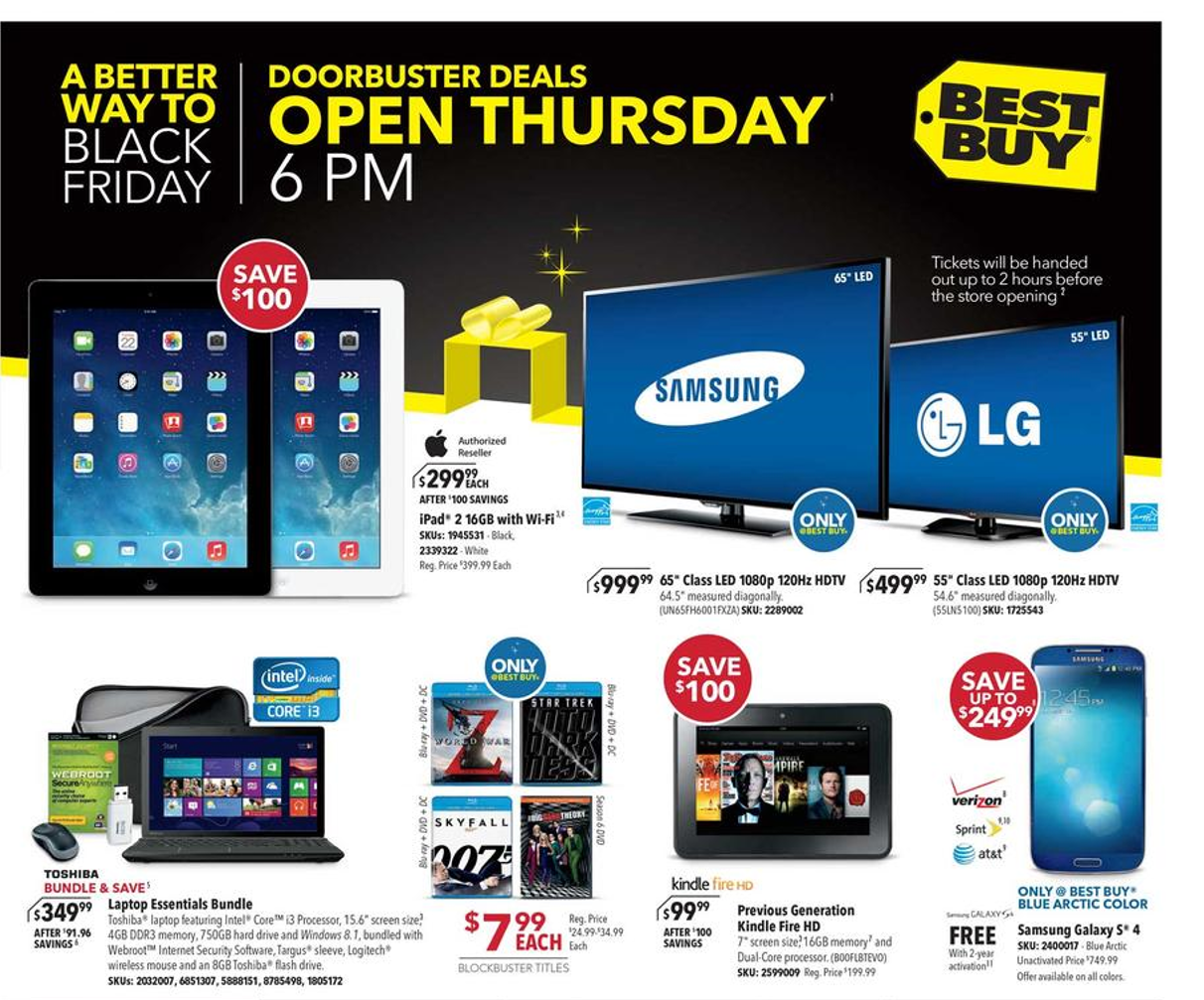
Given Newegg’s contrary claims, however, it’s interesting to consider how retailers’ own promotional decisions might have affected sales. Slickdeals.net scanned the Black Friday circulars forBest Buy, Target, and Walmart. Walmart placed a $278 Toshiba Windows 8 PC on the cover of its Black Friday flyer, but it banished three other notebooks to page 23 of 40—behind Christmas ornaments, power tools, and car tires. Target, which sells 26 different models of Windows notebooks online and in stores, didn’t advertise a single Windows PC. Only Best Buy, which operates Microsoft stores-within-stores via a partnership, put notebooks on each of the first four pages of its circular, and dedicated a separate page to notebooks as well.
If you promote it, they will buy
And then there’s Newegg. Although the online technology retailer has widened its offerings—you can buy Keurig coffee, for example, as well as Toys ‘R’ Us merchandise—it chose to promote notebooks as part of its “Twelve Days of Techmas” sales event. And according to Newegg’s Mills, notebooks, especially ultrabooks, have been the company’s top seller. Mills cited the Lenovo IdeaPad and Asus VivoBook as two popular models during what Mills called “record-breaking sales” on Black Friday and Cyber Monday. “Customers are really seeing the value in [notebooks]—in the form factor, the size, and because Intel has the new [Core] chips in them,” said Mills.
Of course, if heavy advertising and promotion were all it took to sell something, Microsoft wouldn’t be in catchup mode now. But Newegg’s experience seems to indicate that it helps. That’s why Microsoft’s own retail presences, in standalone stores and Best Buy stores-within-stores, could be the real test of whether it can make a dent in holiday sales and beyond. Microsoft doesn’t care whether consumers try out a product in a store, then buy it online for less. As long as it’s a Microsoft product being sold, Microsoft wins.
Microsoft started with its own, standalone stores. Currently numbering 51 nationwide, the stores provide advice, tech support, and a dedicated showroom for both its own products and third-party products.
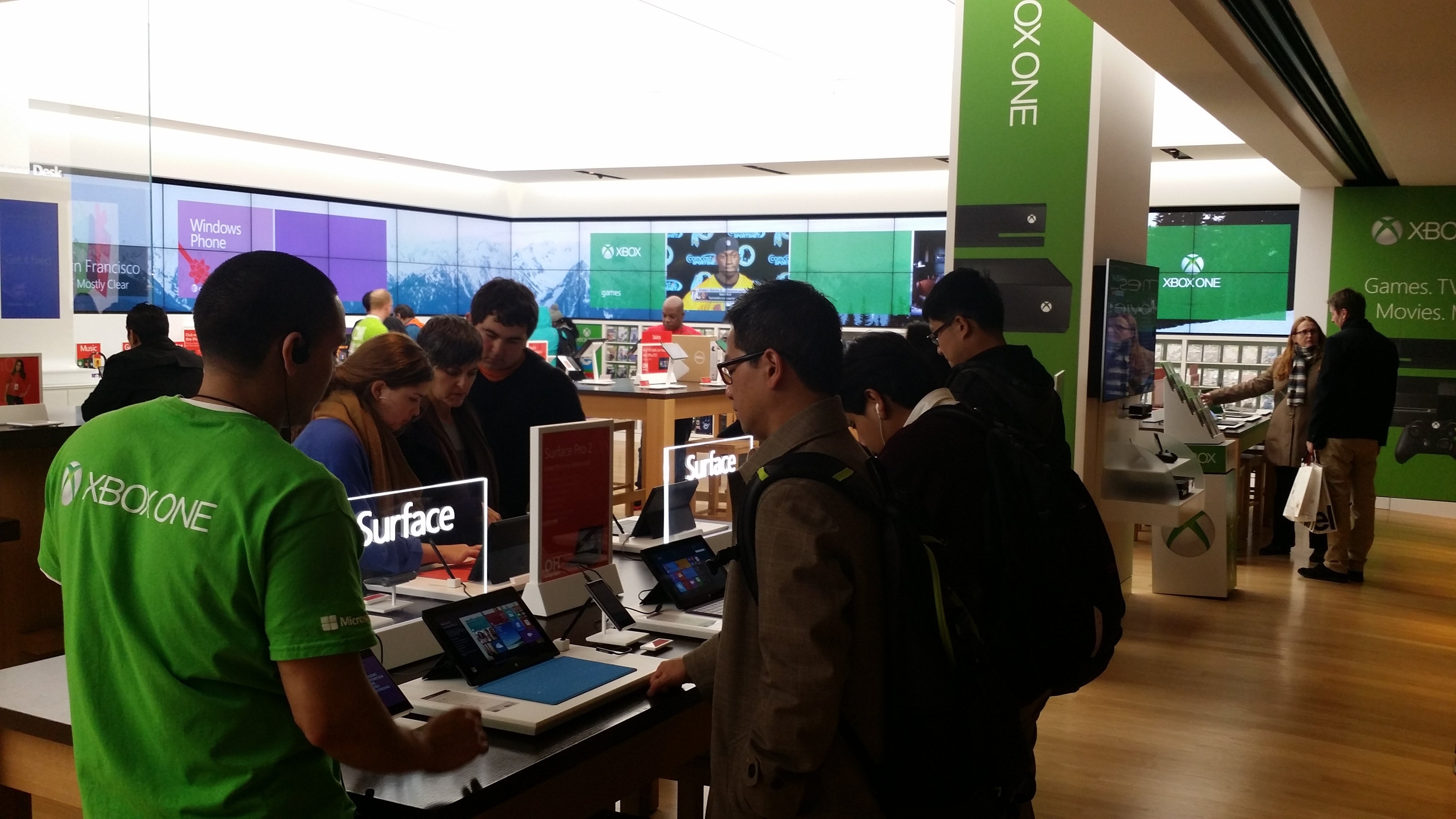
Walk into a Microsoft Store, and chances are that an Xbox One will be displayed in the entrance, attracting a crowd. Inside, you’ll see notebook PCs on one side, along with Surface and other tablets. The friendly staff can explain why, for example, you’d want to buy both a Windows PC and a Windows Phone.
In October, Microsoft chief financial officer Amy Hood said that Microsoft was “set up for a terrific holiday season,” with the Nokia Lumia 1520 and eight-inch Windows tablets from Dell, Lenovo, and Toshiba all priced at $300 or less—and prominently displayed at Microsoft Stores.
Anecdotally, Microsoft Stores appear to be holding their own. Microsoft attracted the same level of traffic within its Westfield San Francisco Centre store as the rest of the mall when I visited last Wednesday night.
Via: PCWorld
 |
| Lumia 2520 |
The Lumia 2520 is Nokia's first attempt at building a Windows tablet. The device runs Microsoft's Windows RT, an operating system dropped by other hardware manufacturers who found little appetite for hardwrae running the OS; as a result, apart from Microsoft itself, Nokia is the only company left still making RT-powered devices now.
I've been using the Lumia 2520 as my everyday tablet for the last couple of weeks and I like it a lot. However, it seems to embody the issues that Microsoft has to tackle when it comes to tablets and the decisions it needs to make around operating systems and the future of Office. (Nokia's devices business will soon be part of Microsoft when its €5.4bn acquisition is complete, of course, and the pair have been collaborating closely on hardware for several years now).
The Bing weather app looks great, as does maps (which I prefer to Nokia's Here), and there's an understanding across the device that big, sharp images play well on tablets. There's clearly a strong design principle behind the UI — the tablet as a next-generation magazine; beautiful, curated, interactive.
But it's striking that the 2520 is also still very much a PC experience, including the irritation of Windows updates. That 16:9 aspect ratio screen that makes it so good for watching video also means that I never felt any desire to use the tablet in portrait mode at all, while the lack of a rounded and bevelled corners (such as on the iPad) made holding it for too long quite uncomfortable and had me longing for a kickstand.
And, while an iPad doesn't feel diminished by the lack of a keyboard, to me the 2520 does — in the same way that the Surface only really makes sense with the keyboard attached. As such, there's something a little bereft about this device, almost as if it's mourning its lack of a keyboard, but soldiering on anyway. Still, Qualcomm's Snapdragon 800 processor keeps everything zipping along.
The Lumia 2520 runs Windows RT 8.1, which does a fine job of the basics. Unfortunately, just doing a fine job of the basics doesn't win prizes anymore. While the default apps are nice, the lack of variety available in the Windows Store (compared to Google Play or Apple's App Store) also reinforces the sense that deep down this machine really wants to be a PC.
One of Microsoft's issues is that Windows has never been a competitive advantage when it comes to selling hardware to consumers: for decades, for most people, it was the only choice they really had.
In the tablet world that's no longer the case: few care that their Kindles or iPads don't run on Windows, even fewer that it doesn't have Office.
Via: ZDNet
 |
| Microsoft CEO |
Satya Nadella -- one of a small handful of alleged internal candidates for the Microsoft CEO job -- has been at the company for 21 years. Since 2011, he's been running Microsoft's lucrative server and tools businesses (His official title, as of the July 2013 reorg, is Executive Vice President of Cloud and Enterprise.)
For the last three years, Nadella, who is a member of Microsoft's senior leadership team, has reported directly to Ballmer.
While there are plenty of critics who've lambasted Ballmer for being slow to respond to changing industry dynamics -- of being a follower instead of a leader -- Nadella said he felt Ballmer struck a better balance than for what he's credited, in terms of cadence and priorities.
Ballmer "is perhaps one of the most grounded people I run across in this place around what our current realities are," Nadella told me during a sit-down interview in Building 34 in Redmond at the end of November, when I talked with him about outgoing Steve Ballmer's legacy.
Nadella recalled a performance review he had with Ballmer two or three years ago.
"I went to him and sort of said, 'Hey, you know, how am I doing?" The first thing he said is,'Dude, you're going to know it, I'm going to know it, so don't keep asking me. You know, we're all going to know what is happening because it's going to be in the air.'
"The second thing I asked him, 'Hey, what about all these past grades and how did they do? And how am I doing relative?'" Nadella said. "He said, 'Why does that matter? Look, this business is not about longevity of any idea. It's all about inventing new formulas. So the thing that I would want to really evaluate you on and I want you super focused on is not how I did or anyone else did with any opportunity we had, because that's not going to tell you anything about the future opportunity.'"
While Ballmer is extremely detail-focused, Nadella said there's never been a meeting win which Ballmer asked something like "have you optimized this CAL (client-access license) with this thing or what have you." Instead, it's "mostly all about what is the next play," Nadella said.
The notion is "there's nothing in this industry -- and definitely in this particular segment -- that's built to last," Nadella continued. "It's all about being able to reinvent yourself.
"And that, I think, is his lasting legacy," said Nadella of Ballmer. "As he would say, it's about batting averages. You're not going to take everything and be a hit. It's not like, oh, we have a great enterprise business. In fact, we have had many enterprise business births and deaths in his tenure."
In the enterprise specifically, Microsoft has evolved from a client-enterprise, to a client-server-enterprise, to a server-workload business. The current phase is cloud. But even that business-model and architectural shift has roots in the so-called Energizer project -- via which Microsoft's IT department provided customers directly with services starting back in 2005.
Nadella said Ballmer told him "all formulas have a timeline or a half-life. And if you don't sort of get focused on inventing the new formula at the right time, you're dead in this business."
At the same time, because everything about Ballmer's approach has been about the long-term, he hasn't been a leader who makes changes haphazardly.
Nadella cited device management as an example.
"There is a very important (management and security) construct called domain join we invented. You could say the IT folks may have misused it to screw up some of the experiences in some cases. But you don't throw the baby out with the bath water.
"You have to reimagine and build new constructs, which we have done with this workplace join," Nadella continued. But we also have to grandfather in other devices into this concept. That doesn't mean we somehow go away from speaking about the virtues. In fact, the fascinating thing that we're seeing now is customers are all realizing, in fact, even our competitors are realizing that this information assurance is probably what enterprises need. They can't willy-nilly let any device come into the enterprise, install any application with no data protection and no ability to test to the device state."
Nadella said Ballmer's often is the first to question new ideas. He cited Microsoft's Windows Intune device security and management service as an example. When Nadella first pitched Ballmer about the evolving bring-your-own-device (BYOD) dynamic and the need to repivot to become more of a cloud service for managing Windows and non-Windows, he got a lot of pushback from Ballmer about the branding, to the concept, to the business model. Why not just continue to rely on System Center, Ballmer wanted to know.
"You come up with an idea, he'll say, 'That's the dumbest thing.' Or, 'I don't buy that,'" Nadella said. "But with him, you've got to just keep going back. You keep going back."
This is a trait Ballmer shared with Chairman Bill Gates, Nadella said. (I can confirm it from an outsider perspective, having been on the receiving end of more than one "That's the stupidest question I ever heard" rants from Gates back when he was CEO.)
"They (Gates and Ballmer) yell at you, they'll scream at you, they'll sort of say you're crazy and you're destroying this place," Nadella said. "And all the melodrama aside, you come back at it with the data, with the -- with your own conviction, because a lot of that stuff is all to test whether you know what you're talking about."
The result: Ballmer may change his position. Sometimes in very big ways.
"I keep my score on that. And whenever he does, and he'll sort of say, 'Yeah, you were right.' And he'll move on," Nadella said.
Via: ZDNet
With just a week and a half to go before Christmas, shoppers are in full-on spending mode, but those looking to score the new Surface 2 or Surface Pro 2 may be disappointed. As of this writing, Microsoft’s online store shows both models and all configurations of the new tablet as “sold out.”
 |
| Microsoft Surface Pro 2 |
A check for either version of the device on Walmart’s online store also showed the device as “out of stock.” A number of customers are also reporting that the device is sold out at Best Buy. However, a quick check of the Best Buy website shows the device as available.
In order to untangle the conflicting stories between online commenters and Best Buy’s website, I conducted my own unscientific test to see what would happen if I called local stores looking for either the Surface Pro 2 or Surface 2 in any configuration. In a random sampling covering three Best Buy stores in New York City, Portland, Oregon and Austin, Texas each local salesperson told me that neither device, in any configuration, was in stock.
And, for the conspiracy theorists out there thinking that this might be some clever retail stunt to make the new Surface seem more popular than it really is, these didn’t appear to be prepared answers that I received as soon as I asked. Each Best Buy salesperson put me on hold (in one case, for 20 minutes) while they conducted a local fact finding mission, ultimately coming up with nothing available.
When I questioned the salesperson in New York City about the shortage, asking if the device was really that popular, she didn’t hesitate when she said the device is “extremely popular.”
Consumers around the country have begun to post their frustrations on Twitter, in some cases directly asking Microsoft when the tablets will be available again.
Source : Mashable
 |
| Microsoft stopped support Windows XP |
Most are aware that Microsoft is soon going to end supports for Windows XP and Office 2003. There won’t be any support options, bug fixes or security updates for these Microsoft products after April 8, 2014. If you have not yet started the migration to a modern operating system, you might want to take a call on it. ‘The end of life’ is the phrase used by mark the end of automatic fixes, updates, or online technical assistance for the Windows XP System.
Subscribe to:
Posts (Atom)


Recent Comments